
Understand the format before placing a roulette bet
 Available in US
Automation can change how a round is presented or entered, but a bet’s meaning still comes from its position on the layout.
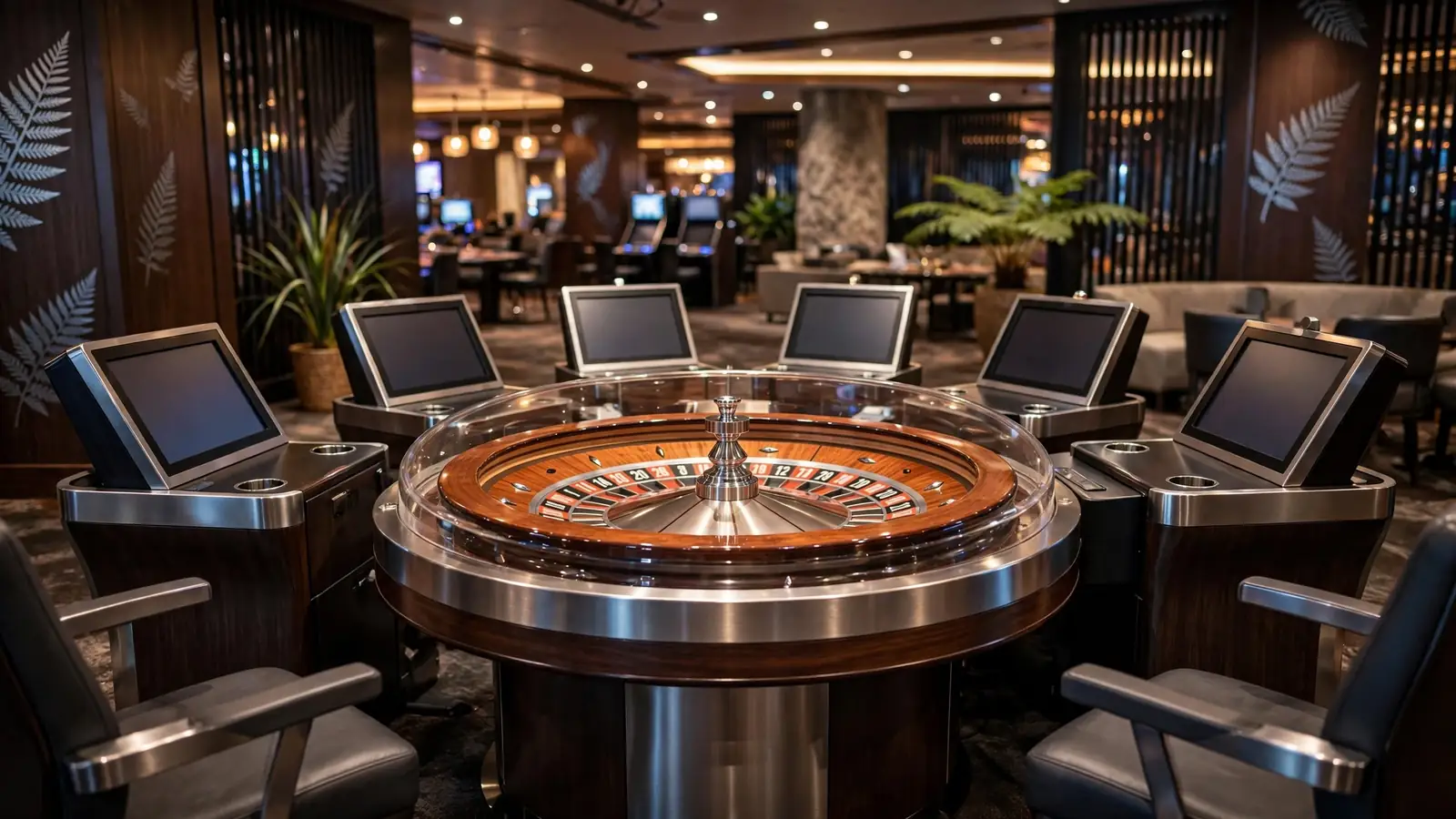
What “Automated” Means at the Roulette Table
At a roulette table, automation does not change the basic choice facing you: select chips, place them on the betting layout and wait for the result. You can stake on a single number, choose red or black, select odd or even, or cover a combination of numbers. The winning number is the one marked on the pocket where the ball comes to rest.
The word “automated” can refer to how a round is run or presented, rather than to a different kind of bet. A digital table may let you place chips through an on-screen layout, while a physical electronic terminal may provide a betting interface. Those descriptions alone do not establish which games, terminals or controls are available at a particular casino. Nor does an automated display alter what a selected bet means: its position on the layout identifies the outcome it covers.
That distinction matters when you are comparing terms such as auto roulette, auto-spin or an automated roulette machine. They can sound like names for specific products, but they may simply describe a format or feature. A search for an auto roulette casino, or for a VIP version, is not proof that a particular product or table is offered to New Zealand players. Availability depends on the operator and the legal conditions under which it may provide online casino gambling in the country.
If you’re considering automated roulette in New Zealand in 2026, use this list as a starting point for checking which operators may suit your needs. The details below are limited to the information available for each operator.
-
Neospin
- License
- Tobique Gaming Commission, licence no. 0000064
Neospin lists a licence from the Tobique Gaming Commission, licence no. 0000064.
-
N1 Casino
- License
- Malta Gaming Authority, licence no. MGA/B2C/394/2017
N1 Casino lists a Malta Gaming Authority licence, no. MGA/B2C/394/2017.
-
Lamabet
- Payout speed
- 1-3 business days
Lamabet’s stated payout speed is 1–3 business days.
-
BitStarz
- License
- Curaçao Gaming Authority, licence no. OGL/2024/165/0185
BitStarz lists a Curaçao Gaming Authority licence, no. OGL/2024/165/0185.
-
Play Grand
- License
- Malta Gaming Authority, licence no. MGA/B2C/370/2017
Play Grand lists a Malta Gaming Authority licence, no. MGA/B2C/370/2017.
-
Zotabet
- License
- 07017519840
- Payout speed
- 1-3 business days
Zotabet lists licence identifier 07017519840 and a payout speed of 1–3 business days.
-
Ricky Casino
- License
- Tobique Gaming Commission, licence no. 0000002
Ricky Casino lists a Tobique Gaming Commission licence, no. 0000002.
-
Wintino
- Payout speed
- 1-3 business days
Wintino’s stated payout speed is 1–3 business days.
-
7Bit Casino
- License
- Tobique Gaming Commission, licence no. 0000091
7Bit Casino lists a Tobique Gaming Commission licence, no. 0000091.
What New Zealand’s 2026 transition means
New Zealand’s position changed during 2026. The Online Casino Gambling Act 2026 took effect on 1 May, creating the country’s first domestic licensing framework for online casino gambling. It does not mean that every online casino can immediately operate under a New Zealand licence. The full licensed system is not expected to be operational until 2027, and the law sets transitional conditions for providers already serving the market.
An online casino that was providing services to people in New Zealand before 1 May 2026 may continue during the transition, which runs through 1 December 2026, subject to the Act’s provisions. A provider that has not applied for a licence must stop conducting online casino gambling in New Zealand by 1 December. If an application is refused, the provider must end its online casino operations in the country and leave the market. Unlicensed operation is expected to become an offence around mid-2027.
The framework assigns distinct responsibilities to two bodies. The Department of Internal Affairs is New Zealand’s primary gambling regulator and oversees the online casino licensing framework. The Gambling Commission handles licence applications, decides whether to grant them and approves changes to licence conditions. These roles concern the provider’s right to operate; they do not certify a particular roulette format or guarantee a particular table’s features.
 Baccarat for Real Money in New Zealand: How It WorksLearn what Player, Banker and Tie bets mean, how hand values determine the winner, and what to compare across baccarat versions and…
 Real-Money Roulette in New Zealand: How It WorksCompare free play with cash wagering, learn how wheel type affects the house edge, and see why European roulette has 37 pockets…
The Gambling Act 2003 does not permit online casinos to be based in New Zealand, and domestic online casinos remain prohibited. Before the 2026 Act, offshore online casino gambling was not licensed or supervised by a New Zealand regulator. Customers using offshore websites in that period had no domestic government recourse. The transition should therefore not be mistaken for a settled system in which every site has a local licence. Residents can access offshore sites, and playing with an offshore operator without a local licence does not make the player liable to a fine or prosecution; the regulatory obligations fall on providers.
For a reader trying to understand automated roulette in New Zealand in 2026, the practical point is that two questions sit side by side. One is how the table accepts a bet and identifies the winning pocket. The other is whether the operator is entitled to serve customers in New Zealand at that point in the transition. A familiar-looking table or a polished automated interface cannot answer the second question.
The legal timetable also limits what an operator may say to attract local customers. Advertising to people in New Zealand is prohibited during the transition period. Licensed operators may advertise under tight rules once that regime applies, while sponsorships are prohibited. A page describing roulette mechanics is not evidence that a named casino or VIP table is legally available, and the presence of a feature label does not settle the licensing position. In 2026, the operating status of the provider is part of the context in which any online roulette option should be understood.
What a Roulette Strategy Can—and Cannot—Change
A roulette strategy is a plan for choosing bets. It can shape what you do at the table: which outcomes you back, how you vary your selections, and when you decide to stop. It cannot determine where the ball will land. In software-based roulette, a random number generator (RNG) produces the result; your betting pattern does not direct that process.
That distinction matters when considering an auto roulette strategy. A plan may make your decisions more consistent, but consistency is not control. Choosing a particular number, colour or combination changes the bet you have placed, not the result generated by the software. A sequence of wins or losses may influence your next choice, but it does not give you a way to set the next outcome.
A plan manages choices, not results
Some players prefer to keep their selections steady, while others change them as they play. Either approach is a choice about betting. The same is true of systems that suggest switching selections after a loss or increasing a bet after a win: they describe how to act, not how to influence the RNG.
A strategy can still serve a practical purpose. It may help you follow a chosen pattern rather than make decisions impulsively. It can also make your approach easier to track. But those are limits on your own behaviour, not advantages over the game’s result process. A method may feel orderly without making its predictions more accurate.
This is the useful test for claims about an automated roulette machine strategy: does it explain a way to choose bets, or does it imply that those choices can control or forecast the generated result? The first is a betting plan. The second asks the strategy to do something it cannot establish.
 Speed Roulette in New Zealand: Rules and OddsLearn how live speed roulette is presented, what a calculator can show, and why wheel rules and zero pockets matter more than…
 Live Casinos in New Zealand: Rules, Games and PaymentsLearn how New Zealand’s online casino framework covers live tables, and what to know about game types, payment methods, regulation checks and…
Why patterns are not forecasts
Roulette outcomes can appear to form patterns. A colour may have appeared repeatedly, or a number may not have appeared for a while. It is tempting to treat that history as a signal about what will happen next. But a record of earlier results does not, by itself, provide a method for directing or predicting the RNG-generated result.
The same caution applies to software presented as an aid to strategy. A tool may organise your selections or display information about your play, but that does not mean it can know the next result. The presence of software alongside the game is not evidence that it has access to a reliable way of predicting the outcome.
If a claim says a system can identify a winning selection in real auto roulette, look for a clear distinction between advice about betting and evidence of control over the result. A confident label, a chart or a complicated sequence does not change the role of the RNG. Without a demonstrated basis for prediction, such claims should not be treated as a reliable edge.
Set expectations before choosing a system
Before following any strategy, decide what you want it to do. If the aim is to keep your choices consistent, a simple rule may help. If the aim is to make a software-generated result more predictable, no betting pattern can provide that control. Those are different expectations, and confusing them can make a strategy sound more powerful than it is.
Do
- Use a strategy to keep your selections consistent
- Use a plan to help you follow a pattern
- Use a method to make your approach easier to track
Don't
- Assume a strategy can determine where the ball lands
- Believe that consistency provides control over the RNG
- Treat a record of earlier results as a forecast
It is also worth separating a plan from a promise. A strategy may specify what you will bet under different circumstances; it cannot promise that those choices will win. Calling a sequence “automated” does not alter that boundary. Automation can describe how decisions are carried out, but it does not turn a chosen bet into influence over the RNG.
The practical limit is straightforward: you control your selections, while the software determines the result through its random number generator. A strategy can organise the first. It cannot command the second.
Auto Roulette, Without the Product Labels
“Auto roulette” is a broad description, not a guarantee that a particular game, table or control is available. It generally points to roulette presented in an automated format: the round follows the table’s rules, and the player uses an interface to take part. The label alone does not tell you exactly how a round is presented or what options the table offers.
The wording can also be confusing because “automated” may describe different parts of the experience. It might refer to how the round is run, how a result is displayed or how a bet is handled. Those are not interchangeable features. A title containing “auto” does not, by itself, establish that bets can be repeated automatically, that a ball is physically spun, or that a particular version is offered to New Zealand players.
A useful way to read the term is as a general format label rather than a specific product name. The basic idea remains roulette: you make a selection under the table’s rules, a result is produced, and any winning bet is paid according to its type. That settlement may be automatic, but it does not mean the player’s choices or the game’s rules have changed.
The label also does not settle how the result is generated. That depends on whether the roulette is software-based or presented with a live dealer, a distinction that matters more than the word “auto” when you want to understand the source of a result. The name alone is not enough to identify which one you are looking at.

This is why terms such as “automated roulette” and “roulette in an automated format” are more useful as descriptions than as promises about a feature set. A casino may use different wording for a similar format, while the same label can be applied to experiences that are not identical. Read the table information for its actual rules and presentation rather than assuming the label supplies those details.
If you are comparing tables, separate the format from the options offered at the table. A general label does not confirm a particular betting control, practice mode, special rule or interface. Nor does it establish that a named title exists or is available in your location. Those details need to be stated by the operator; the word “auto” cannot do that work.
In short, auto roulette is best understood as a broad description of roulette played through an automated presentation, not as a distinct set of rules or a particular product. The term can orient you, but it cannot tell you everything about how a specific table works.
How Live Auto Roulette Differs from Software Roulette
The key difference between live dealer roulette and software-based roulette is how the result is generated. Software-based roulette uses a random number generator, or RNG: a system that produces the result within the game software. Live dealer products do not use an RNG system. The word “live” therefore points to a different result-generating process, not simply a more realistic-looking version of the same software.
In software roulette, the result is produced digitally. The table may show familiar roulette imagery and let you place bets through an on-screen interface, but the visual presentation does not change the role of the RNG. The software determines the result, and the displayed result represents that digital process. A roulette layout on screen is not evidence that a physical wheel is involved.

With a live dealer product, the result is not generated by an RNG. The game is presented as a live table, with a dealer and the physical roulette process determining the outcome. That is the important distinction: the result comes from the live game rather than being produced by a software random-number system. A digital interface may still be part of the experience, but that does not make the result software-generated.
This can make the phrase “live auto roulette” confusing. “Auto” may suggest that software is generating the result, while “live” indicates a live dealer product. The labels alone are not a reliable way to tell which kind of roulette you are looking at. Focus on whether the product is described as live dealer roulette or software-based roulette, and on the stated way its result is generated. The distinction is about the source of the outcome, not how the table is styled.
Neither category should be treated as a promise of a particular result. In software roulette, an RNG generates the result; in live dealer roulette, the product does not use an RNG. That difference does not make either result predictable to you. Nor does a live presentation mean that the game follows different roulette betting principles. It identifies the format and the result-generation method, rather than offering a way to influence what happens.
For a New Zealand player, it also matters not to confuse a game format with an operator’s legal status. The Online Casino Gambling Act 2026 created a domestic licensing framework, with a transition for providers that were already operating before the law came into force. During that transition, existing providers may continue under the Act’s transitional provisions; the full licensing regime is expected to be operational in 2027. A live dealer label does not itself establish that a provider is licensed or eligible to operate.
So, when comparing live and software roulette, keep the central distinction narrow: software-based roulette uses an RNG, while live dealer products do not. Interface details and marketing names may vary, but they do not replace that distinction. Check what kind of product is being described and how its result is generated; do not infer the answer from the word “auto” alone.
Software-based Roulette
Uses a random number generator (RNG) to produce the result digitally within the game software.
Live Dealer Roulette
Uses a physical roulette process with a dealer to determine the outcome; it does not use an RNG.
Roulette Software, Betting Tools and Electronic Tables
The word “software” can refer to different things around a roulette game. It may mean the system that determines a software-based result, the screen where you select bets, or a separate tool someone claims will analyse or predict play. These are not interchangeable. A betting interface can help you enter a choice; it does not follow that it controls or forecasts the result.
In software-based roulette, a random number generator (RNG) determines the result. The RNG is the system producing the game outcome; it is distinct from the buttons, chip controls or other elements through which you interact with the table. The interface is where you make selections. The result-generation system is what determines the outcome. Calling both of them “roulette software” can blur a distinction that matters.
That distinction is also useful when assessing automated roulette betting software. A program or built-in control that places a selected bet is a betting tool, not evidence that the program can influence the RNG. Automation describes an action being carried out by software; it does not, by itself, say anything about how the result is generated or whether the outcome can be anticipated. The same caution applies to claims about online roulette prediction software: a tool’s label or confident presentation is not proof that it can identify the next result.

An RNG-based result is not something you can infer simply from the betting screen or from a record of earlier outcomes. A prediction claim would need evidence that it can determine the result produced by the game’s RNG. Without that, the claim should not be treated as a reliable way to know what will happen. Software can organise information or enter choices without giving you control over the outcome.
An electronic roulette terminal is another part of the picture, but the term alone does not establish how a particular machine operates. A terminal might be discussed as a way to interact with a roulette game, while “semi-automated” might describe a process involving both player input and software. Neither label tells you, on its own, whether the terminal generates the result, passes a bet to another system, or offers a particular set of controls. Those details depend on the specific product and should not be assumed from a general description.

When you assess a tool, separate what it demonstrably does from what it claims to do. Does it provide a way to enter or organise bets, or does it promise to forecast outcomes? The first describes an interface function. The second is a claim about knowing a result generated by an RNG, and the label “automated” does not establish that ability.
In short, software may be involved both in presenting a roulette table and in producing a software-based result, but those roles are different. A terminal or betting aid should not be mistaken for a result-prediction system. The important point is not how sophisticated the interface looks; it is whether a claim about the outcome has a sound basis.
How a Spin Resolves and Bets Are Paid
A roulette round reaches its deciding point when the ball comes to rest in a numbered pocket. That pocket supplies the winning number. The result is not decided by the colour or position of a chip on the table; those choices determine which bets may win once the pocket is known.
Settlement follows the bet you placed. A wager on one number depends on whether that exact number is the result. A bet on red or black is assessed against the pocket’s colour, while an odd-or-even bet is assessed against its number. A combination bet covers the numbers included in that selection. These are different ways of relating your wager to the same result, not separate ways to influence where the ball lands.
Once the result is established, the table processes winning wagers without requiring the player to calculate or request payment. The amount returned depends on the kind of bet made. That is the useful meaning of automatic settlement: the system applies the relevant bet category to the result and pays a winning wager accordingly. It does not mean every wager receives a return, or that the payment is the same for every type of bet.

For instance, a selected number must match the pocket for a number bet to qualify. With a colour bet, the number itself is less important than whether the pocket is red or black. An odd-or-even wager is judged by that property of the winning number. A combination covering several numbers is assessed against the numbers it includes. In each case, the pocket determines the result and the bet type determines whether the wager wins and how it is settled.
This is also the practical answer to how automated roulette works at the end of a round: the result is identified from the pocket, then eligible bets are paid based on their selection. Automation concerns how the round and settlement are handled; it does not change the relationship between a bet and the result. Nor does it make an unsuccessful selection payable simply because the table is automated.
The phrase “auto-play roulette” can suggest that a spin and its settlement happen without the player manually handling each step. But it should not be confused with a different settlement rule. Whether a player has interacted with an automated table or an interface uses automated controls, the winning number still comes from the pocket where the ball stops, and payment still follows the kind of wager made. The label does not tell you the terms of a particular control or product.
There are no auto roulette tricks that can change this sequence. A betting choice can define what counts as a win for that wager, but settlement is not a way to revise the result after the ball has landed. The clearest way to read a completed round is therefore to identify the pocket first, then compare it with each bet. If the selection qualifies, the table pays it according to its type; if it does not, there is no winning payment for that bet.
Free Play and Roulette Simulators: What the Facts Establish
A roulette simulator can mean software that lets you explore a roulette-style game, while free play suggests using it without staking money. Those labels alone do not tell you whether a particular site offers either option, or how its version works. They are not evidence of a specific free mode, automatic-spin control or simulator feature.

The relevant distinction is how the result is produced. Software-based roulette uses a random number generator, or RNG: software that produces the result rather than a physical ball and wheel deciding it. If a free-play or simulator option is software-based roulette, its result is generated by an RNG too. Calling it a simulator does not, by itself, explain the system behind it.
Nor does the word “free” establish that a game reproduces every aspect of a paid version. It describes an intended way to play, not a guarantee about the software, rules or available controls. A feature that repeats spins automatically, if offered, would not tell you whether the results were generated by an RNG or how the game was configured. The label and the result-generation method are separate questions.
For you, the practical point is to avoid treating a demonstration as evidence about a particular game or feature. A simulator may be useful for becoming familiar with a roulette interface, but its name alone cannot establish what options it includes. Likewise, seeing an automatic-spin control would not show that it changes how a software-generated result is determined.
This is also why “free roulette” should not be read as a promise that a specific mode is available. The general fact is narrower: software-based roulette options operate with RNGs. Whether a particular simulator offers free play or automatic spins must be established from that specific offering, rather than inferred from the term.

In New Zealand, the legal setting for online casino services is changing under the Online Casino Gambling Act 2026. The Act came into force on 1 May 2026, and the transitional period allows providers already serving New Zealand customers before that date to continue until 1 December 2026. The full licensed regime is expected to be operational in 2027. A free-play label does not, by itself, establish a provider’s status under that framework.
Live Roulette, VIP Tables and La Partage
A live roulette table and a VIP label describe different things. “Live” refers to a dealer-led product; VIP is a designation an operator may use for a table or a category of players. Neither label, on its own, tells you what rules apply or who can take part.
The key distinction about how a live result is produced is straightforward: live dealer products do not use a random number generator (RNG). That separates them from software-based roulette, where an RNG generates the result. It does not establish that a particular live table is available, how it is run, or what conditions apply to it.
VIP tables can sound like a promise of a distinct experience, but the label is not a rulebook. It does not, by itself, confirm eligibility, access requirements, betting terms or any special treatment. Those details would need to be stated by the operator for the particular table. Without them, “VIP” is only a label, not evidence of what a player will receive.
La Partage is another term you may encounter alongside live roulette. Its name alone does not tell you whether a table applies the rule, or how the rule affects a bet. Do not assume that every live table offers La Partage, or infer its terms from the table’s title. The relevant information is the table’s stated rules, not the presence of a familiar phrase in a description.
This matters when a listing combines terms such as live, VIP and La Partage. They do not necessarily describe one shared feature: one may refer to the dealer format, another to a category or access label, and another to a rule. A combined heading cannot establish that the table has all three, or explain the conditions attached to them.
Before relying on any of these labels, look for the rules attached to the specific table and read what they say about access and play. If the operator does not clearly set out a claimed feature, the label cannot fill in the missing detail. The point that can be stated about live dealer roulette is narrower: its products do not use an RNG. That fact does not confirm VIP eligibility or La Partage terms.
Auto-Betting Does Not Change the Bet’s Terms
An auto-bet feature, where a table provides one, is a way to place or repeat a bet according to a selection you make. It does not alter what that bet covers or give it a different chance of winning. Automation concerns the action of placing a wager, not the terms of the wager itself.
At a roulette table, you choose chips and place them on the layout. You might select a specific number, red or black, odd or even, or a combination of numbers. Auto-betting is relevant only to how a selected bet is entered or repeated; it does not turn one kind of bet into another. A wager on red remains a wager on red, whether you place it yourself each time or use a repeat function.
Do not assume that every table offers the same controls. The presence, operation and available settings of an auto-bet option depend on the table or service, so check its instructions before using it. In particular, a repeat control should not be treated as proof that a previous selection will be placed exactly as expected. Confirm the bet shown on the table before relying on it.

The practical risk is straightforward: if you have not checked the selected chips and positions, automation can repeat a choice you did not intend to make. It saves a manual action, not judgment. Decide what you want to bet, verify the selection, and remember that repeating it does not improve its prospects. No setting can change the kind of wager you selected merely by placing it automatically.
Auto-betting is therefore best understood as an interface convenience, not a roulette system. The bet’s meaning still comes from where you place the chips and which outcome or group of outcomes you choose.
Does “30 Seconds” Describe a Roulette Rule?
A reference to thirty seconds does not, by itself, define a roulette rule or establish how long a live round lasts. It may appear beside descriptions of automated or live roulette, but the number should not be treated as a standard spin duration, a guaranteed betting window or a fixed interval between rounds.

The outcome rule is separate from any clock or countdown shown on a screen. In roulette, the winning number is the number on the pocket where the ball comes to rest. A timer does not determine that number, and the presence of a countdown would not change how the result is decided.
That distinction matters when comparing claims about live play. A page or interface that mentions a thirty-second interval could be describing a particular display or process, rather than a rule shared by roulette tables. Without details tied to a specific table, the number alone cannot tell you when bets close or when a round begins.
So, if you see “30 seconds” associated with live auto roulette, read it as a timing claim that needs context—not as a universal feature of the game. The reliable point is narrower: the numbered pocket containing the ball determines the winning number. That is the rule relevant to the result; a duration attached to a description is not a substitute for it.
Table & Live Casino Games in New Zealand
Content created by the «casinohubnz.com» team