
Understand the table before you place a bet
 Available in US
Explore how blackjack tables work, how rule variations affect decisions, and what to check when betting online or in a casino.
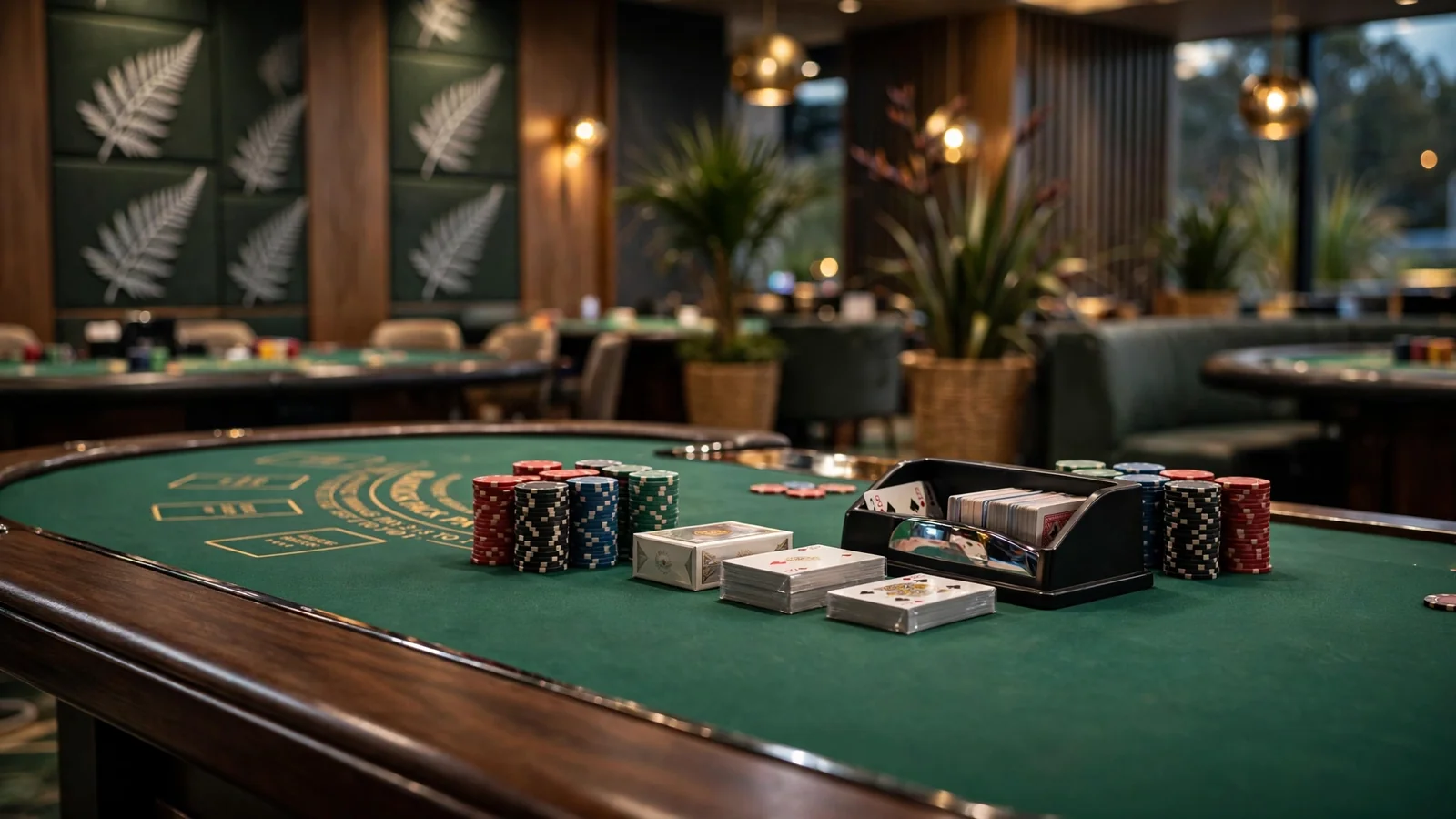
What a Blackjack Table Offers
A blackjack table is a shared playing space: you see the dealer, the cards and the other seats arranged around the same game. In a physical casino, that space is a felt-covered table. Online, it may be a digital interface or a live video feed. The central aim remains recognisable, but the experience depends on whether the cards are dealt by a person or generated by software.
At a live table, a dealer handles actual cards while a camera streams the action to your screen. The video gives you a view of the dealing area and the dealer’s movements, rather than a set of card animations produced entirely by the game software. That makes the format closer to being at a casino table, although you are watching through a screen rather than sharing the room. The distinction is practical: the cards are real, but your view of them is mediated by the stream.
A live blackjack table often presents the dealer and playing area as the main focus, with the seats around it represented on screen. You may be able to see where other participants are playing and follow the same deal from your own device. The exact arrangement depends on the game interface. Some screens give more space to the video; others put controls and game information alongside it. Before joining, take a moment to see whether the cards and the active parts of the table are easy to follow on your screen.
Choosing a blackjack table in New Zealand means looking for an option that fits your preferences and offers clear information you can assess. Use these brief notes as a starting point when deciding where to play.
-
Neospin
- License
- Tobique Gaming Commission, licence no. 0000064
Neospin lists a licence from the Tobique Gaming Commission, number 0000064. You can use this detail as one point of reference when considering its blackjack tables.
-
N1 Casino
- License
- Malta Gaming Authority, licence no. MGA/B2C/394/2017
N1 Casino lists a Malta Gaming Authority licence, number MGA/B2C/394/2017. That licensing information may help you assess the site before exploring its blackjack offering.
-
Lamabet
- Payout speed
- 1-3 business days
Lamabet lists a payout speed of 1–3 business days. You can consider this stated timeframe alongside your blackjack preferences.
-
BitStarz
- License
- Curaçao Gaming Authority, licence no. OGL/2024/165/0185
BitStarz lists a Curaçao Gaming Authority licence, number OGL/2024/165/0185. You can take this licensing detail into account when reviewing its blackjack tables.
-
Play Grand
- License
- Malta Gaming Authority, licence no. MGA/B2C/370/2017
Play Grand lists a Malta Gaming Authority licence, number MGA/B2C/370/2017. This is a useful detail to review as you consider its blackjack offering.
-
Zotabet
- License
- 07017519840
- Payout speed
- 1-3 business days
Zotabet lists licence number 07017519840 and a payout speed of 1–3 business days. These are the available details to consider when exploring its blackjack tables.
-
Ricky Casino
- License
- Tobique Gaming Commission, licence no. 0000002
Ricky Casino lists a Tobique Gaming Commission licence, number 0000002. You can use this information as a reference when considering its blackjack offering.
-
Wintino
- Payout speed
- 1-3 business days
Wintino lists a payout speed of 1–3 business days. You can weigh this stated timeframe as you explore its blackjack tables.
-
7Bit Casino
- License
- Tobique Gaming Commission, licence no. 0000091
7Bit Casino lists a Tobique Gaming Commission licence, number 0000091. This licensing detail can be part of your review of its blackjack offering.
The presence of other players can make a live game feel communal, even when everyone is connecting remotely. You are watching one shared table rather than playing in isolation, and the dealer’s actions provide a visible sequence to follow. Depending on the interface, other participants may be shown as occupied seats or represented mainly through their play at the table. A busy-looking screen is not necessarily easier to understand, so clarity matters more than decoration.
There is also a human pace to the live format. The dealer has to handle the cards and move the game along, while the stream carries those actions to you. A connection or streaming delay can make the picture lag behind the table. This may be minor, but it can affect how immediate the experience feels. The game is not simply a video of a casino: your screen is part of an interactive service, and the timing of what you see matters.
A software-based blackjack table offers a different kind of presentation. The cards and dealing sequence are shown through the game interface, without a live dealer physically handling them on camera. That can make the screen feel more direct and self-contained. You focus on the game display and its controls, rather than on a person dealing at a shared table. Software games can also move at a faster pace than live-dealer games, since they do not need to show the physical handling of cards.

Neither format is automatically the better fit. If seeing actual cards dealt is important to you, the live version offers that feature. If you prefer a compact screen and a brisker rhythm, software play may feel more straightforward. The useful question is not which one looks more like a casino, but which presentation lets you follow what is happening without confusion. A live table can feel more social and tangible; a software game can feel more self-contained.
The comparison is worth making before you settle into a session. In a live game, the stream is part of the experience, and a delay may interrupt its flow. Some live tables may also require higher bets than software games, so the format can affect what is available to you as well as how it looks. Do not assume that every live option is interchangeable with every software version. Check the displayed information for the particular table rather than relying on its label or appearance.
Live Blackjack Tables
Actual cards are handled by a dealer and streamed via video, offering a communal feel and a human pace.
Software Blackjack Tables
Cards and dealing sequences are rendered via a digital interface, providing a faster pace and a self-contained experience.
A free casino blackjack table, where one is offered, can let you become familiar with a screen layout without wagering real money. But “free” describes the way you play, not necessarily the realism of the experience: a software demonstration does not reproduce the timing or human presence of a live dealer. If you are comparing formats, notice what the screen shows, how the cards are presented and whether the pace suits you. Those details are more useful than a polished background or a dramatic camera angle.
The phrase “online casino table” covers more than one format. It might mean a software game on a computer or phone, or a streamed live table with a dealer. Look for clear labels and inspect the table before joining. A live-dealer title should make the video and dealing area apparent; a software game will present the action through its digital interface. On a small screen, controls can take up space and the cards may be harder to see, so a quick look at the full display is worthwhile.

What a blackjack table offers, then, is not just a place to play but a particular way of seeing and following the game. Physical tables bring people together around actual cards; live online tables transmit that format to your device; software games render the action directly on screen. Each has a different rhythm and feel. Knowing which format you are opening helps you understand what to expect before the first hand begins.
Rules, Payouts and the Insurance Question
Blackjack rules can change what a hand is worth, whether a hand can continue, and how much a winning natural pays. The table felt and the game title are not enough to tell you which version is in play. Read the displayed rules before joining, and check that they apply to the specific table rather than to another game from the same operator.
A specialist review describes variation between games in deck count, the dealer’s treatment of soft 17, surrender availability and natural-blackjack payouts. These details are not minor wording differences: together, they define the game being offered. The dealer’s soft 17 is a hand containing an ace counted as 11 and a total of 17. One table may require the dealer to draw on it, while another may require the dealer to stand. That changes how the dealer’s hand can develop, even though the player’s cards are unchanged.
Surrender, where offered, lets you give up a hand under the table’s stated conditions and forfeit part of the original wager rather than continue. Whether it is available, and when it can be used, depends on the rules. A table may also specify how a natural blackjack is treated if the dealer has one as well. Check such details in the rules panel: assumptions carried over from another blackjack game can lead to a mistaken expectation about the result.
What a natural blackjack pays
A natural blackjack is a two-card hand that totals 21. It is different from reaching 21 after drawing more cards, and its payout may be different. A specialist review reports that some tables advertise a natural payout of 3:2, while others use 6:5. These are payout ratios, not odds of being dealt the hand.
The distinction matters because the ratio determines the profit on a winning natural relative to the original wager. With 3:2, the profit is one and a half times the wager; with 6:5, it is one and one-fifth times the wager. The original wager is returned as well, subject to the table’s settlement rules. A lower natural payout means a smaller return for the same winning hand. Look for the payout in the game’s rules before you play rather than relying on a general description of blackjack.
Do not confuse a natural’s payout with the result of every hand that reaches 21. A total made after taking another card can still win against the dealer, but it is not thereby converted into a natural. The distinction is why the payout wording matters: it identifies the specific hand that qualifies, not every winning total.
Why insurance deserves caution
Insurance is a separate wager offered when the dealer’s visible card is an ace. It concerns whether the dealer has a natural blackjack; it is not protection against every way the player might lose. If the dealer does not have a natural, the insurance wager loses, regardless of whether the player’s own hand later wins. If the dealer does have one, the insurance wager pays according to the table’s stated terms.
For most players, insurance is generally a poor bet because its payout does not make the underlying event favourable often enough to compensate for the times it fails. The offer can sound like a sensible safeguard, especially when the player has a strong hand, but it is still an additional wager with its own outcome. It does not improve the player’s cards or change the main hand’s rules. Treating it as protection can obscure that it is a separate bet.

The practical point is not to make insurance a routine part of play. Read how the table handles it, and consider it independently from the original hand rather than as a way to preserve a likely win. If its terms are unclear, ask the dealer at a physical table or consult the game information before placing it. The same care applies to the main rules: a table’s payout, soft-17 requirement, deck setup and surrender terms belong together, and you need the complete set to know what you are playing.
Online Blackjack: Software Games and New Zealand’s Licensing Transition
An online blackjack table can be run by software or streamed from a live-dealer studio. With a random-number-generator game, software shuffles the cards, and hands can move more quickly because there is no physical dealing or video stream to wait for. Live-dealer games use actual cards; the stream brings the dealer and table to your screen, but connection delays can interrupt the pace, and some games may require higher bets.
The difference is more than appearance. In a software game, the interface handles the deal and records your choices. Live play follows the dealer’s actions as they happen on camera. Neither format changes the basic aim of blackjack: to finish closer to 21 than the dealer without going over. A faster game can mean less time between decisions, so consider whether its pace suits you before starting.
What changes in New Zealand during 2026
New Zealand’s first domestic licensing framework for online casino gambling comes from the Online Casino Gambling Act 2026, which took effect on 1 May 2026. Its arrival changes the position from the preceding period, when online casinos operating from overseas were not licensed or supervised by a New Zealand regulator. Customers using those sites then had no domestic government recourse if a dispute arose.
The new framework does not mean every online casino is locally licensed straight away. A transitional period runs from 1 May to 1 December 2026. During that window, online casinos that were already serving people in New Zealand before the Act began may continue operating under the transitional provisions. The full licensed regime is not expected to be operational until 2027.
The Department of Internal Affairs is New Zealand’s primary gambling regulator and oversees the online casino licensing framework. The Gambling Commission handles licensing decisions: it considers and determines applications, grants online casino licences, and approves changes to licence conditions. These are distinct roles within the framework, not interchangeable labels for one regulator.
The transition also sets limits on continued operation. Providers that have not applied for a licence must stop conducting online casino gambling in New Zealand by 1 December 2026. If an application is declined, the provider must cease its online casino operations in the country and leave the market. Unlicensed operation is expected to become an offence around mid-2027; operators may face enforcement action and fines of up to NZ$5 million.
Licensed operators will have to use stricter age and identity checks. Advertising by licensed operators is permitted only under tight rules, and sponsorships are prohibited. During the transition, online casino gambling must not be advertised to people in New Zealand. These restrictions matter even when a site’s games are easy to access: availability alone does not establish that an operator holds a New Zealand licence.

For someone choosing an online blackjack table in 2026, the practical point is that the regulatory status depends on the transition stage and the operator’s circumstances. The new framework is being introduced in phases, rather than appearing fully formed on the date the Act commenced. Before the licensed regime is fully operational, a site may still be accessible without being locally licensed. New Zealand players are not liable to a fine or criminal prosecution merely for playing at an offshore casino without a local licence, but access should not be confused with domestic oversight or the recourse that licensing is intended to provide.
How Rule Variations Shape Blackjack Strategy
A blackjack strategy is not a set of instructions that works identically at every table. It is a way of choosing among available actions under a particular set of rules. Change those rules and the relative value of a decision can change too. A chart that is appropriate for one game may therefore give the wrong instruction at another.
Basic strategy is built around the probabilities of possible outcomes: the cards you might receive, the dealer’s upcard and what the table permits you to do. It does not predict the next card. Instead, it identifies the choice with the best expected result for a given situation under stated rules. That qualification matters. A strategy chart is useful only when its assumptions match the game in front of you.
The number of decks is one assumption that can affect the calculations. So can whether the dealer draws on a soft seventeen, a hand containing an ace counted as eleven without busting. Surrender availability and the treatment of a natural blackjack also belong in the rule set. These details are not decorative footnotes: together, they shape the probabilities behind recommended decisions and the house edge, the casino’s mathematical advantage over time.
This is why a blackjack probability table should not be treated as a universal reference. A chart may look authoritative while being based on a different deck count or dealer rule. Before relying on one, compare its stated assumptions with the table’s rules. If those details are not available, the chart’s recommendations may not fit the game, however neatly they are laid out.
The same principle applies to a blackjack surrender table. Surrender is not offered everywhere, and guidance about when to use it depends on the rules and the situation represented in the chart. A reference designed for a game that permits surrender cannot simply be carried over to a table where the option is absent. Nor should a single entry be detached from its conditions and treated as a general instruction.

Payouts also affect strategy because they change the value of outcomes. A natural blackjack paying three to two does not produce the same return as one paying six to five. A specialist review has described tables with both payout terms; that is a reason to check the stated pay table, not to assume either applies everywhere. When a payout is less favourable, it can also make the game’s overall mathematical balance less favourable to the player. The pay table and the play chart answer different questions, but both matter: one describes what an outcome pays, while the other guides choices under the game’s rules.
Rule changes do not necessarily point in the same direction. A game may have one feature that is more favourable to the player and another that is less so. You cannot reliably judge the whole table by noticing just one rule. Nor does a favourable-looking rule guarantee a good result in any individual hand; blackjack still involves uncertain outcomes.
For practical use, match a strategy reference to the exact game rather than searching for a chart labelled simply “blackjack.” Check the deck count, dealer procedure, surrender conditions and payout terms shown for that table. If a private blackjack table has its own rules displayed, those are the rules to compare with the reference; the private setting itself does not make a chart more accurate or improve the odds.
A chart can organise decisions, but it cannot remove the house edge or guarantee a winning session. Betting systems do not change the rules or turn an unfavourable expectation into a reliable profit. The most useful blackjack table strategy begins with knowing which game the chart describes—and recognising when it describes a different one.
Do
- Match your strategy reference to the exact game rules
- Check deck count and dealer procedures
- Set a budget before you start
Don't
- Use a universal chart for different rule sets
- Rely on betting systems to guarantee profit
- Increase stakes to recover losses
Placing Bets and Using Chips at the Table
A blackjack bet is placed before a hand begins. It sets the amount at stake for that hand; it is separate from the choices you make after the cards are dealt. Once play is under way, the focus shifts from placing the initial wager to responding to the hand. Keeping those stages distinct makes it easier to follow what is committed and what is still in your control.
At a live table, you use physical chips rather than cash on the playing area. You place your wager in the marked betting space in front of you, where the dealer can see it. The chips represent the value of your bet, and the dealer handles them as the hand is settled. If you are new to a table, take a moment to observe how bets are placed before joining in; clear, visible wagers help prevent misunderstandings.
An electronic blackjack table game replaces physical chips with an on-screen interface. You select a stake using the controls provided and confirm it before the hand starts. The display shows the amount wagered, but the action is still a real-money decision if you are playing for cash. A tap or click can feel less tangible than putting chips on felt, so pause to check the displayed stake rather than treating the button as a casual part of the game.
In either format, set a budget before you play and decide what you can afford to lose. Keep that amount separate from money needed for ordinary expenses. If a session goes badly, do not raise your stake simply to recover losses; chasing them can turn a planned amount into an unplanned one. A budget is useful only if you stick to it.

If you are considering a bonus, read its conditions before depositing or wagering. Check the fine print on trustworthy sites and casinos, including any maximum-bet rules that apply while meeting wagering requirements. Blackjack may count differently from other games toward those requirements, so a wager shown on screen or represented by chips may not contribute in the way you expect. Do not assume that every hand advances a bonus on the same terms.
The practical routine is simple: know the amount you are putting at risk, confirm it before the hand begins, and keep track of your remaining budget. Physical chips make a stake visible on the table; an electronic display makes it visible on screen. Neither format changes the need to understand the conditions attached to play, or makes a bet less consequential because it is represented by a chip or a button.
When to Hit, Stand, Double Down or Split
During a blackjack hand, you choose how to respond to the cards you have and the dealer’s visible card. The available actions depend on the table’s rules, so check what is permitted before play begins. A choice changes how your hand continues; it does not guarantee a particular result.
Available Actions
Depending on the table's rules, you may choose to hit (take another card), stand (keep current hand), double down (increase stake and limit cards), split (separate an eligible hand), or surrender (give up the hand).
Hit: take another card
To hit is to ask for another card. Its value is added to your hand, which may bring you closer to 21—or take you over it. If your total exceeds 21, you bust and lose the hand. You can ask for another card again if the table allows it and you have not bust.
In practice, hitting means accepting more uncertainty in exchange for a chance to improve your total. Consider the cards already in your hand and the dealer’s upcard before deciding. There is no single “hit” instruction that fits every hand, because the situation changes with the cards and the rules.
Stand: keep your current hand
To stand is to take no more cards. Your hand stays as it is, and play moves on according to the table’s dealing sequence. The aim is still to finish closer to 21 than the dealer without exceeding 21. Standing avoids the risk of drawing a card that pushes your total over 21, but it also leaves your hand unchanged.
A blackjack hit-or-stand chart can show choices for different hands and dealer upcards. Treat a chart as a reference, not a promise: its guidance may assume particular table rules, and another game may differ. If you are unsure what a button or hand signal means, ask the dealer before acting.
Double down, split or surrender
Depending on the rules, you may also be able to double down, split or surrender. Doubling down changes your stake and limits how the hand continues, so confirm the conditions at that table before selecting it. Splitting turns an eligible hand into separate hands; each then has to be played under the table’s procedure. Whether either action is available can depend on the game.
Surrender, where offered, lets you give up a hand rather than continue playing it. Its conditions vary, so do not assume when it is permitted or what happens to your stake. The table’s displayed rules are the point of reference.
Make each decision when it is your turn, and check the available options rather than pressing a button by habit. If the game does not offer an action, it is not available for that hand under its rules.
Choosing a Seat and Following the Hand
A blackjack table brings several players together to play against the same dealer. Each player has a place at the table and follows their own hand; the dealer’s hand is the common opponent. The aim is to finish closer to 21 than the dealer without going over. Other players are sharing the table, not competing with you for the best hand.
If you are new to a particular table, take a moment to watch how the hand moves from one player to the next. The layout shows where players sit and where their cards are placed. The dealer manages the shared game, while each player makes decisions for their own hand when it is their turn. Watching a round can make the sequence easier to follow before you join in.
There is no seat that improves your chance of beating the dealer. A position may affect when you act in the sequence, but it does not change the aim of the game or make the cards more favourable. Claims that one end of a blackjack table is the best place to sit should not be treated as a way to gain an edge.
Choose a seat for practical reasons instead. You may prefer a spot where you can see the cards and hear the dealer clearly, or one that gives you enough room to follow the play without feeling crowded. If you want time to get familiar with the layout, a quieter table may feel easier to observe, provided its stated conditions suit you. Comfort can make the game simpler to follow; it does not alter the outcome.
Once seated, keep your attention on your own hand and the dealer’s. Other players’ choices may be visible, but each hand is resolved against the dealer rather than against the people beside you. You do not need to copy another player’s decisions or assume their actions determine what will happen to your cards.
Before joining, check that you understand how play is organised at that table and how the dealer signals whose turn it is. If anything about the layout or sequence is unclear, ask before the hand begins. That is more useful than trying to infer a rule from another player’s move. A seat should help you see and follow the game, not promise better odds.
Reading Blackjack Cards and a Strategy Chart
A hand’s total depends on the value assigned to each card. Number cards count at face value, so a seven adds seven to the hand. A king, queen or jack counts as 10. An ace can count as either 1 or 11, depending on which value helps the hand without taking it over 21.
That flexibility makes an ace different from other cards. A hand containing an ace counted as 11 is often called a soft hand: if another card would push the total beyond 21, the ace can instead count as 1. A hand with no ace, or with an ace that must count as 1, is hard. The distinction matters because the same apparent total can behave differently when another card is dealt.
A card-value table is a useful reference when you are learning or returning to the game. It lets you check the basic values at a glance rather than rely on memory, especially when an ace changes how a total is read. Once the values feel familiar, the table becomes less necessary, but the ace remains worth checking carefully.
A blackjack strategy chart serves a different purpose. It lays out possible decisions according to your hand and the dealer’s visible card, so you can find the relevant situation without trying to remember every combination. The chart is an organising aid, not a promise of a particular result. It also needs to match the rules of the game you are playing; charts made for different rule sets may not recommend the same action.
Read the hand total first, including whether an ace can still count as 11. Then locate the corresponding situation on the chart and follow its labels. A chart can make a complicated set of choices easier to navigate, but it cannot remove chance or substitute for checking that it applies to the table in front of you.
Using a Strategy Chart
-
1
Read the hand total
Determine your current total and check if an ace can still count as 11 (soft hand).
-
2
Locate the situation
Find the corresponding hand total and the dealer's visible upcard on the chart.
-
3
Follow the label
Identify the recommended action provided by the chart for that specific combination.
Using a Blackjack Cheat Sheet Without Relying on Systems
A blackjack cheat sheet is a compact reference for decisions at the table. It can help you consult a strategy chart without trying to memorise every entry, particularly when you are learning how a particular game’s rules affect the choices shown. It is a guide to decisions, not a prediction of what the next card will be.
A blackjack table cheat sheet should match the game you are playing. Rules can differ, and a chart made for one set of conditions may not fit another. Check the table’s stated rules before relying on a reference, and treat the chart as a prompt to think rather than an instruction that guarantees a result. The dealer’s next card remains unknown; no layout of advice can remove that uncertainty.
That distinction matters when a “system” is presented as a way to ensure a win or recover losses. A chart organises choices using the information available in a hand. A system that promises a reliable profit makes a much larger claim. Neither a sequence of bets nor repeated use of a reference changes the uncertainty of the game. Set a budget before playing, and do not increase it to chase losses.
Card counting is different from using a basic decision chart. It involves mentally keeping track of cards that have appeared and using that information to assess what may remain. Mental card counting is not illegal under New Zealand law. That does not make it a dependable method for every format: online games using automatic shuffles do not provide a basis for assuming that a count will help.
Use a cheat sheet to reduce the burden of remembering, not to hand responsibility to a promise. Read its instructions carefully, confirm that they fit the table, and accept that a sound decision can still be followed by an unfavourable result. A reference can make your process clearer; it cannot control the cards or guarantee an outcome.

Checking Table Limits Before You Play
A table’s minimum and maximum stakes define the range of bets it accepts. Check both before joining: the minimum needs to fit your budget, while the maximum matters if you expect to raise a bet during play. A limit that looks manageable at first can still leave little room to adjust your stake, so read the table information rather than relying on its name or appearance.
Limits are only part of the conditions to review. If you are considering a bonus, read its terms before depositing or playing with real money. Wagering requirements—the conditions for completing the play needed to qualify for a bonus or withdraw related funds—can treat blackjack differently from other games. The contribution assigned to blackjack may be lower, or otherwise different, so time spent at the table may not count as you expect.
Check whether a maximum-bet rule applies while you are meeting wagering requirements. A bet that is within the table’s displayed limit may still exceed a separate cap in the bonus terms. If those conditions are unclear, do not assume the table limit overrides them. Compare the wording on the casino’s site with the table information, and use trustworthy sources to check the fine print before committing money.
The useful limit is therefore not simply the largest stake shown. It is the stake range you can afford, alongside the conditions that apply to your play. Set a budget before you start and do not increase it to recover losses. If the minimum is beyond that budget, or the bonus terms make the maximum bet unclear, choose not to join. A table is not a financial plan, and its displayed limits do not describe what you can afford to lose.
What is card counting?
Card counting is mentally keeping track of cards during play; using mental calculation alone is not illegal under New Zealand law.
Is card counting illegal?
No. Using mental calculation to count cards is not illegal under New Zealand law.
Does blackjack always pay 3:2?
No. A natural blackjack often pays 3:2, but some tables pay 6:5; check the specific table’s rules.
Table & Live Casino Games in New Zealand
Content created by the «casinohubnz.com» team