
A Practical Guide to Real-Time Casino Tables
 Available in US
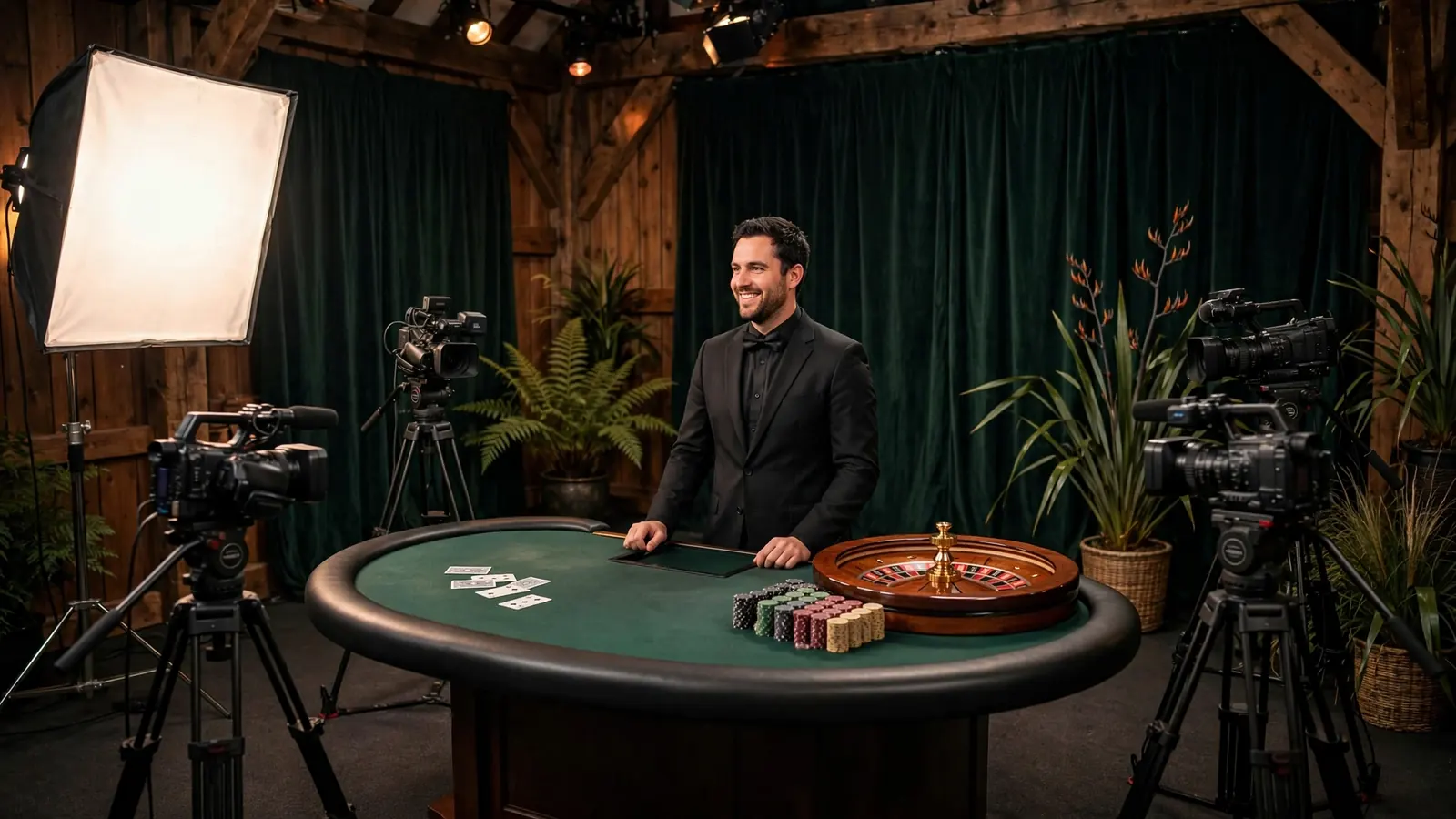
Live dealer games pair real cards or roulette wheels with a video stream and an online interface for remote participation.
How Live Dealer Tables Bring the Casino Floor Online
A live dealer casino brings a physical table into an online game through a real-time video broadcast. Instead of watching a computer-generated dealer or relying only on an animated display, you see a professional dealer handling cards or operating a wheel at a studio table. The game takes place in front of a camera, while the software presents the broadcast and lets you take part remotely.
The stream may come from a dedicated studio or a casino based in a particular country. Either way, the central feature is that the cards and wheel are real, and the dealer’s actions are shown as they happen. You can follow the table through the video feed and interact with the dealer during play. That gives the format a visible human presence, although the experience still depends on an online connection and a screen.
This is what people mean when they ask what a live dealer casino is: an online casino format built around games conducted by real dealers on camera. It is not simply a recorded clip placed beside a digital game. The broadcast and the online interface operate together so that players can participate while the round is taking place.
Choosing a live dealer casino is easier when you can check the details that matter to you before deciding where to play. Use this list as a starting point and verify that each option suits your needs.
-
Neospin
- License
- Tobique Gaming Commission, licence no. 0000064
Neospin lists a licence from the Tobique Gaming Commission, licence no. 0000064. You can use that information as one point of reference when assessing the casino.
-
N1 Casino
- License
- Malta Gaming Authority, licence no. MGA/B2C/394/2017
N1 Casino lists a Malta Gaming Authority licence, no. MGA/B2C/394/2017. You can consider this licensing detail when reviewing the operator.
-
Lamabet
- Payout speed
- 1-3 business days
Lamabet lists a payout speed of 1–3 business days. You can factor that stated timeframe into your choice.
-
BitStarz
- License
- Curaçao Gaming Authority, licence no. OGL/2024/165/0185
BitStarz lists a Curaçao Gaming Authority licence, no. OGL/2024/165/0185. You can take this licensing information into account when considering the operator.
-
Play Grand
- License
- Malta Gaming Authority, licence no. MGA/B2C/370/2017
Play Grand lists a Malta Gaming Authority licence, no. MGA/B2C/370/2017. You can use the licence details as part of your assessment.
-
Zotabet
- License
- 07017519840
- Payout speed
- 1-3 business days
Zotabet lists the licence reference 07017519840 and a payout speed of 1–3 business days. You can review both details when deciding whether it fits your preferences.
-
Ricky Casino
- License
- Tobique Gaming Commission, licence no. 0000002
Ricky Casino lists a Tobique Gaming Commission licence, no. 0000002. You can consider that detail when evaluating the operator.
-
Wintino
- Payout speed
- 1-3 business days
Wintino lists a payout speed of 1–3 business days. You can use the stated timeframe as one factor in your decision.
-
7Bit Casino
- License
- Tobique Gaming Commission, licence no. 0000091
7Bit Casino lists a Tobique Gaming Commission licence, no. 0000091. You can take this information into account as you assess the operator.
The appeal is partly about seeing events unfold rather than having every action represented by graphics alone. A dealer shuffles or deals, a wheel turns, and the result is presented live. You are still playing remotely, not sitting at the table, but the camera gives you a view of the physical game and the person running it.
Live dealer tables therefore sit between an online game and a visit to a casino floor. They bring some of the table’s visible activity to your device without making the setting local or private: other players may be taking part in the same game, and the dealer is working in a broadcast environment. The defining combination is straightforward—real equipment, a professional dealer, and a live feed that lets you join the action in real time.
What to Check Before Playing from New Zealand
The rules for online casino gambling in New Zealand are changing, so the date matters when you assess a site. The Online Casino Gambling Act 2026 took effect on 1 May 2026, establishing the country’s first domestic licensing regime for online casino gaming. That does not mean every offshore site immediately became locally licensed, or that players can identify a Kiwi-specific casino licence: New Zealand has no separate licence of that kind.
Before the new law, online casinos operating from overseas were not licensed or supervised by a New Zealand regulator. The Gambling Act 2003 did not permit online casinos to be based in New Zealand, but it did not prevent Kiwi players from accessing offshore platforms. The new framework changes the regulatory position for providers; it does not make every offshore site an approved New Zealand operator.

The Act includes a transition from 1 May to 1 December 2026. Casinos already serving people in New Zealand before the law took effect may continue during that period, subject to the Act’s transitional provisions. This is a temporary arrangement, not confirmation that a site has secured a licence. An operator’s claim that it is available to Kiwi players should therefore be read separately from any claim that it is authorised under the new system.
From 1 December 2026, the legal permission to accept New Zealand players is limited to 15 approved operators. The Act allows no more than 15 licences for the online casino sector, covering live dealer tables as well as online pokies and digital table games. The cap applies to the sector, not just to live dealer casinos. The full licensed regime is expected to become operational in 2027, so the transition date and the longer process of establishing the system should not be treated as the same milestone.
Check the operator’s status, not just its wording
When a site describes itself as licensed, establish which authority issued the licence and whether that authorisation covers online casino gambling. A foreign licence is not a New Zealand licence, and a general statement about being regulated does not by itself show that the operator is approved to serve Kiwi players under New Zealand’s new system.
For a check on the domestic position, consult the Department of Internal Affairs (DIA). Confirm the operator’s status with the DIA rather than relying only on a badge, a footer statement or the casino’s own explanation. If a site refers to an application or approval, look for confirmation from the relevant authority and note whether it concerns a licence, a pending application or transitional permission. These are different statuses and should not be presented as interchangeable.
The distinction is especially important around the transition. A provider already operating before 1 May may be allowed to continue temporarily under the Act’s provisions; that does not establish that it will be among the approved operators from 1 December. Nor does a foreign regulator’s oversight answer the separate question of whether the provider is permitted to accept New Zealand players under the domestic regime.
New Zealand players are not prohibited from accessing offshore gambling platforms. That practical access should not be confused with local supervision or with an assurance that a dispute will be handled by a New Zealand regulator. Before the Act, customers wagering with offshore sites had no domestic government recourse. A site’s availability, its foreign regulatory status and its New Zealand authorisation are separate considerations.
If you cannot verify what a licensing statement means, treat it as unconfirmed rather than filling the gap with the operator’s own wording. Check the date of the claim as well as the authority named: a statement made during the transition may no longer describe the provider’s position after the deadline. For a live dealer casino in New Zealand, the relevant question is not simply whether the tables can be opened from the country, but whether the operator’s status matches the rules in force at the time you use it.

What Makes a Live Dealer Casino Feel Real
The convincing part of a live dealer casino is not simply seeing a person on screen. The physical action at the table has to match the game state shown on your device. A card dealt in the studio must be recognised by the software as the same card represented in the digital interface; otherwise, the video and the game could tell different stories.
Live dealer games are broadcast from a studio or a casino in a particular country, with real dealers handling the play. The feed gives you a view of the table as events happen, while casino software records the information needed to run the digital game. In live blackjack, one important link between those two parts is the card-scanning process.
Cards used at the table contain embedded markings or chips. A barcode scanner reads them, allowing the software to identify each card and keep the digital game aligned with the physical deal. The dealer handles the cards; the scanner supplies the software with information about what has been dealt. That connection is what lets the screen show a recognised card rather than merely a video image of one.
This distinction matters when judging whether a table feels genuinely live. A video feed can show a dealer and a table, but the game also depends on the underlying system registering what happens there. In blackjack, card scanning helps join the visible deal to the software’s record of the round. The dealer’s actions and the information on your screen are therefore parts of one process, not separate displays.
The same principle applies more broadly to live tables: a real setting provides the action, and software makes that action usable through an online game. The exact arrangement can differ between studios and casino-based broadcasts, but the essential point is the link between what happens physically and what the interface represents. When that link works, you can follow a real deal through the screen without needing to treat the game as a pre-recorded scene.
Playing Live Dealer Games Online: Timing and Technical Limits
A live table asks you to follow a game as it unfolds, rather than play at a pace set entirely by software. The dealer’s actions and the table appear through a live video feed, while your bets and choices are entered through the casino interface. That combination makes the experience feel immediate, but it also means that timing and connection quality matter.
Most live games give you a limited window to place a bet. The countdown is part of the game’s pace: when it ends, betting closes and the dealer moves on. You may have less time to compare options or change your mind than you would in a game that lets you pause between rounds. If you are still learning the controls, the extra pressure can be noticeable. It is sensible to watch how the interface works before joining a round, so you are not trying to work out where to click while the betting window is closing.
The live format can also feel less predictable in pace than an automated game. The table has to accommodate a dealer and, in many cases, several players acting in turn. Some rounds move briskly; others include pauses while the table progresses. The fixed betting window sets a boundary, but it does not make every part of the session equally fast. If you prefer to take your time, a live table may feel demanding even when the game itself is familiar.

When the video and controls do not match
A live game depends on a working connection between the video stream and the controls on your screen. A delay, frozen image or interrupted stream can make it harder to tell what is happening or whether an action has registered. The consequences depend on where the interruption occurs: a brief pause while watching is different from losing the connection as betting closes. Do not assume that a click has been accepted simply because you made it; check the table display when it becomes available.
Technical problems are possible, but they should not be described as a constant feature of live play. A specialist review has noted that live dealer games can encounter technical issues from time to time. That is a caution, not a prediction about any particular session or casino. If the video stops or the controls behave unexpectedly, use the operator’s stated support route and look for its explanation of how interrupted rounds are handled. The answer matters more than a general claim that a service is reliable.
Your own setup affects how clearly the table can be followed. A stable connection and a device that displays the video and betting controls comfortably can make it easier to act before the window closes. If the stream is already struggling, opening other demanding applications may not help. These are practical checks, not guarantees: a problem can still occur at the casino’s end or in the connection between the service and your device.
Do
- Watch the interface before joining a round
- Check the table display after making a click
- Contact support if the video stops
Don't
- Assume a click is accepted without verification
- Open demanding apps when the stream struggles
- Repeatedly submit the same action during delays
It is also worth distinguishing a slow picture from a slow game. The dealer may continue while your screen is delayed, so the image you see might not represent the table’s latest state. Avoid placing further bets until you can tell what the interface has recorded. If you cannot verify the status, stop interacting and contact support rather than repeatedly submitting the same action. Repeated clicks can create uncertainty about what was accepted.
Decide whether the pace suits you
Before playing for money, read the on-screen instructions and observe the timing of a round. Check how the interface signals that betting is open or closed, and where it shows an accepted action. This helps you judge whether the pace is comfortable without relying on assumptions about a particular table. Live games are typically not offered as free-play products, because operating a staffed, streamed table carries costs for casinos; therefore, do not count on being able to practise at every live table without wagering.
If you want a slower experience, consider whether you are comfortable making decisions within a defined window and continuing through a streamed round without pausing it. If not, stepping away is a reasonable choice. The live video adds immediacy, but it also takes control of the pace away from you. A well-functioning stream cannot remove that basic trade-off, and a technical interruption can make it more consequential.
Live Blackjack, Roulette and Baccarat: What the Games Involve
These live dealer casino games share a table format, but the decisions and odds differ. Blackjack centres on your hand against the dealer’s. Roulette asks you to predict where a wheel will stop, while baccarat is about which of two hands will finish closer to a target.

In live blackjack, the aim is to beat the dealer with a total higher than theirs without exceeding 21. You make decisions about your hand as the game progresses; the dealer also takes a turn. The central tension is simple: a stronger total can improve your chance of beating the dealer, but going over 21 means losing the hand. Blackjack therefore involves choices as well as the luck of the cards.
Roulette has a different structure. You place a wager on an outcome associated with the wheel, then the result depends on where the wheel’s ball lands. The version matters to the house edge, the mathematical advantage built into the game over time. For live European roulette, the stated edge is about 2.7%; for American roulette, it is about 5.26%. Those figures describe the game’s long-run structure, not a prediction of what will happen in an individual session.
Baccarat gives you a choice of betting on the banker hand or the player hand. A draw is also a possible result. The objective is to predict which hand will have the higher value, with the winner being the hand closest to 9. The stated house edge is about 1.06% on a banker bet and 1.24% on a player bet. The difference is modest, but it means the two choices are not mathematically identical. A draw is a possible outcome, so check how a particular table treats that bet before playing.
House-edge figures can help compare the underlying mathematics of games, but they do not tell you whether a particular wager will win. They are also tied to the game version and bet type: roulette’s European and American wheels differ, while baccarat’s banker and player bets have separate figures. Blackjack’s objective is easy to state, but its choices make it a different proposition from games where you mainly select an outcome before the result is revealed.
Live Blackjack
Beat the dealer with a total higher than theirs without exceeding 21.
Live Roulette
Predict where the wheel will stop, with house edges of approximately 2.7% (European) or 5.26% (American).
Live Baccarat
Predict whether the banker hand or player hand will finish closest to a value of 9.
Choosing a Casino with Live Dealers Without Relying on a Ranking
A ranking can narrow the field, but it cannot establish whether a live dealer casino is suitable for you. Order may reflect a site’s editorial criteria, while the details that matter to a player—who regulates the operator, what the rules say, and whether the service is clear about its terms—need checking individually. Treat a list as a starting point, not as evidence that a casino is safe or right for you.
Kiwi players can access live dealer games at international and offshore gambling sites. That access does not mean an offshore operator is supervised by a New Zealand regulator. Before opening an account or depositing, check which gambling body regulates the site and whether the operator’s licence can be independently confirmed. A regulator’s name displayed on a website is not, by itself, proof that the licence is current or covers the service being offered.
Check who is responsible
Look for the operator’s legal name and its stated regulator in the site’s terms or licensing information. Then compare those details with information published by the regulator. Check that the licence belongs to the same company operating the casino, rather than assuming that a familiar brand name and a licence reference necessarily match. If the operator’s identity or regulatory status is difficult to establish, that uncertainty is a reason to pause rather than a detail to overlook.

For a check relevant to New Zealand, confirm the operator’s licence status with the Department of Internal Affairs (DIA). The DIA can help establish what status applies; a casino’s own description should not be treated as a substitute for that check. Regulation matters because it identifies an oversight framework and a party responsible for meeting its requirements. It does not remove every risk or guarantee that you will have a satisfactory outcome if something goes wrong.
New Zealand does not issue a Kiwi-specific online casino licence. That makes it especially important not to confuse an offshore licence with domestic approval. The practical question is not simply whether a site says it is licensed, but who issued the licence, whether the named operator holds it, and whether the DIA’s information supports the status being claimed. If the answers do not line up, do not rely on reassuring wording or a prominent badge.
Read the practical details before joining
Once you have checked the operator’s status, read the terms that govern ordinary use of the site. Look for clear explanations of account requirements, verification, restrictions and how the operator handles questions or complaints. These details should be available before you commit funds. If important conditions are scattered, contradictory or written so vaguely that you cannot tell what they mean, consider whether you are comfortable proceeding.
Pay attention to whether the casino distinguishes its own rules from those of a game provider. A table’s displayed rules may explain how that game operates, while the site’s terms set out the operator’s conditions for account use. Both can matter. Do not assume that a polished stream or professional-looking studio tells you anything about the operator’s oversight or the quality of its customer service.
- Identify the legal name of the operator
- Confirm the regulator and current licence status
- Verify the operator's status with the DIA
- Review account requirements and verification terms
- Locate clear channels for raising complaints
Check what support channels are available and whether the site explains how to raise a complaint. A contact option is more useful when the operator identifies who handles the issue and what process follows. If you need clarification, seek it before depositing, and keep a record of the relevant terms and any response. An answer that avoids the specific point is not the same as a clear resolution.
The word “best” is not a finding you can verify on its own. A casino that suits one player may not suit another, and a prominent position in a comparison does not prove regulatory standing. Make your own short list of questions: Can you identify the operator? Can you verify its regulatory status? Are the conditions understandable? Can you find a clear way to contact the operator and raise a concern? If any answer remains uncertain, that is useful information in itself.

A careful choice is less about finding a flawless live dealer casino than about knowing who you are dealing with and what terms apply before you play. Check the operator independently, read the conditions directly, and do not let a ranking stand in for either step.
Live Dealer Casino Bonuses: Check the Conditions and Limits
A live dealer casino bonus should be treated as a conditional promotion, not as extra money you can assume will be available for every table. Before accepting an offer, read its terms and check whether it applies to live dealer games at all. Conditions may distinguish between game types, so a promotion that appears on a casino site may not cover the tables you intend to play.
The terms should also explain what you must do before bonus funds or any related winnings can be withdrawn. Check how the offer defines eligible games, the period in which it can be used, and any restrictions on withdrawing funds. If those conditions are unclear, the headline offer tells you little about its practical value.

New Zealand’s rules matter alongside an operator’s own conditions. The Online Casino Gambling Act 2026 took effect on 1 May 2026, beginning a transition towards a licensed domestic regime. From 1 December 2026, only 15 approved operators may legally accept Kiwi players under the new rules. A promotion should not be read as evidence that an operator is authorised to serve New Zealand customers.
There are also limits on the promotion itself: bonus offers are capped at NZ$100 or 200% of the deposit. These are ceilings, not promises that a casino will make an offer at either level. During the transition, online casino services must not be advertised to people in New Zealand. That restriction makes it especially important to distinguish an operator’s permitted service from promotional claims encountered elsewhere.
Read the terms in full and consider whether taking an offer is worthwhile given its restrictions. Do not rely on a banner, a short description or the word “bonus” alone. The relevant questions are whether the offer is lawful under the rules applying at the time, whether the operator may accept Kiwi players, and whether the conditions suit the games you plan to play. If any answer is uncertain, declining the promotion avoids taking on conditions you have not been able to assess.
Payments and Withdrawals at Online Live Tables
The payment method attached to a live-dealer account can affect how long it takes to receive a withdrawal, but published timings are not guarantees. They may describe a particular operator’s process rather than a standard that applies across online casinos with live dealers. Check the cashier and withdrawal terms of the site you are considering, and treat any stated timeframe as an estimate subject to its conditions.
Typical withdrawal timeframes
A specialist casino review reports that crypto withdrawals can clear in under an hour, e-wallets (POLi, Neteller, Skrill) take 24 to 48 hours, and bank transfers take 5 to 7 business days.
A specialist casino review reports that crypto withdrawals can clear in less than an hour. In the same review, POLi and e-wallet withdrawals are given a window of 24 to 48 hours, while bank transfers are described as taking 5 to 7 business days. Those figures are useful as a comparison of the methods discussed, not as a promise about what your casino will deliver. The operator, payment provider and any checks on the account can affect the process.
It also helps to distinguish a casino’s processing time from the time taken for money to reach your account. A withdrawal may need to be reviewed before it is sent, and the receiving payment service has its own role after that. Read the operator’s explanation of when its clock starts and ends; otherwise, two sites quoting the same timeframe may not be measuring the same stages.
Check the currency and the method
Many operators allow deposits and withdrawals in New Zealand dollars. Where that option is available, using an NZD account can make it easier to see the amount being paid in or out without converting every transaction yourself. Still, check what currency the payment method actually uses and whether a conversion could occur elsewhere in the process. A displayed account currency does not, by itself, tell you whether every transaction is settled in that currency.
Payment choices can also differ between deposits and withdrawals. A method shown in the cashier for adding funds may not be available when you request a payout. Before depositing, check that the method you intend to use is accepted for withdrawals too, and note any rules about withdrawing through the same channel used to deposit. These details are operator-specific, so a general list of available payment types cannot settle them.

A specialist casino review identifies Neteller, Skrill and Bitcoin among methods associated with fast deposits or withdrawals. It also cautions that restrictions or fees may apply. That is a description of methods, not a guarantee that every casino accepts them or handles them at the same speed. Bitcoin is a crypto option, while Neteller and Skrill are e-wallets; the operator’s cashier should spell out which are supported and what conditions attach to each.
Read the conditions before moving money
Look for fees on both sides of a transaction: those charged by the casino and those that may be applied by a bank, wallet or crypto service. The terms should also explain any minimum or maximum transaction rules, verification requirements and steps required before a withdrawal is approved. These limits and conditions vary, so do not assume that a method’s advertised speed tells you the full cost or process.
Keep a record of the method selected, the stated timeframe and any confirmation shown when you request a withdrawal. If the payment is delayed beyond the operator’s published estimate, that record gives you a clear basis for asking its support team what stage the transaction has reached. Faster reported processing is only one consideration; the practical choice is the method whose timing, currency and conditions you can verify before you deposit.
How to Read Claims About the Top Live Dealer Casinos
A label such as “top live dealer casino” is a judgement, not a regulatory category. It may describe an editorial comparison, a promotional claim or simply a site’s own description. Treat it as a prompt to check the operator, not as evidence that the business is approved to serve Kiwi players.
Start by identifying which company runs the site and which entity holds its gambling licence. An offshore operator should be regulated by a recognised gambling body; a logo or licence number on a webpage is not enough on its own to establish that the details are current or apply to the company you are dealing with. Check the regulator’s own records where possible, and make sure the operator name matches.
That check is separate from confirming the position in New Zealand. The Department of Internal Affairs (DIA) is the authority to contact or consult for an operator’s status under the domestic framework. New Zealand does not issue a Kiwi-specific licence, so a foreign licence and domestic approval are not interchangeable. A recognised offshore regulator may provide oversight in its jurisdiction, but it does not by itself confirm permission under New Zealand’s rules.
The Online Casino Gambling Act 2026 took effect on 1 May 2026 and created a transition period. From 1 December 2026, only approved operators may legally accept New Zealand players under the new regime. Before relying on a claim that a casino is among the leading choices, check whether its status is relevant to the date you plan to play and confirm it with the DIA. A ranking can become out of date as the regulatory position changes.
Also distinguish a review’s opinion from verifiable details. Praise for a live table, a polished website or a broad selection of games does not answer who regulates the operator or whether its New Zealand status has been confirmed. Give greater weight to claims that identify the responsible company and point to a regulator’s current information. If a page uses “top” prominently but leaves those basics unclear, the wording tells you little about the safeguards behind the service.

How Live Blackjack and Baccarat Rounds Play Out
At a live blackjack table, your turn comes in sequence. You make decisions against the dealer’s hand, while other players at the table take their turns too. That shared pace can make a round slower than blackjack played against a random number generator, where software does not need to wait for other people or a dealer. If you prefer to decide and move on quickly, the difference matters; if you like following the table’s rhythm, waiting is part of the format.
The choices available during your turn depend on the table’s rules and the cards in front of you. The central aim is to beat the dealer without taking your total over 21. You may need to consider your own hand, the dealer’s visible card and the possibility that another decision will leave you over the limit. Live play does not remove those calculations, but it makes them happen within the flow of a shared round. A pause can be useful for thought, yet the table continues to move once play resumes.

Baccarat asks for a different kind of decision. Before the hands are resolved, you choose whether to back the banker or the player. The round can end in a banker win, a player win or a draw. You are predicting which hand will finish with the higher value; you do not make the same sequence of hand-by-hand decisions as in blackjack.
Pay attention to the betting window before committing. Some live baccarat tables impose time constraints on players’ hands, so the available time to place a bet may not suit someone who wants to compare options at length. Once the window closes, you may have to wait for another round rather than join the one in progress.
For either game, the table’s pace is part of the choice, not a minor interface detail. Check how quickly decisions are called, whether the display makes the current stage clear and whether you can follow the action without rushing. A live table can feel less solitary than software play, but that means your decisions take place alongside other players—and on the table’s schedule.
Can New Zealand players play real-money live dealer games at offshore casino sites?
Yes, you can play at offshore sites. From 1 December 2026, only approved operators may legally accept New Zealand players, so check an operator’s status with the Department of Internal Affairs.
How many operators can hold a licence?
Up to 15 operators can hold licences for the online casino sector, including live dealer tables.
Which live dealer games can New Zealand players usually access?
You can find live blackjack, roulette and baccarat at live dealer casinos.
What games can I play at a live casino?
You can play live blackjack, roulette and baccarat, with real dealers running the games over a live video feed.
Table & Live Casino Games in New Zealand
Content created by the «casinohubnz.com» team